Journal
Box styles explained: which custom box style fits your product?
Three families of boxes
Almost every custom box belongs to one of three families, and the family decides the look, the strength and how the box ships to you:
- Folding cartons — printed paperboard that is cut, creased and glued, then delivered flat. Retail and cosmetic boxes, food cartons and most shelf packaging.
- Corrugated boxes — board with a fluted middle layer for strength and cushioning. Mailer and shipping boxes. See corrugated flute types.
- Rigid boxes — thick greyboard wrapped in printed paper, usually delivered assembled. Gift, jewellery and premium presentation boxes. See rigid box vs folding carton.
Within each family, the style is the shape of the dieline: how the box closes, how the base is formed and whether it has inserts, windows or hanging tabs.
Tuck end boxes
The classic retail carton. The ends close with a flap that tucks inside the box, held by small friction locks.
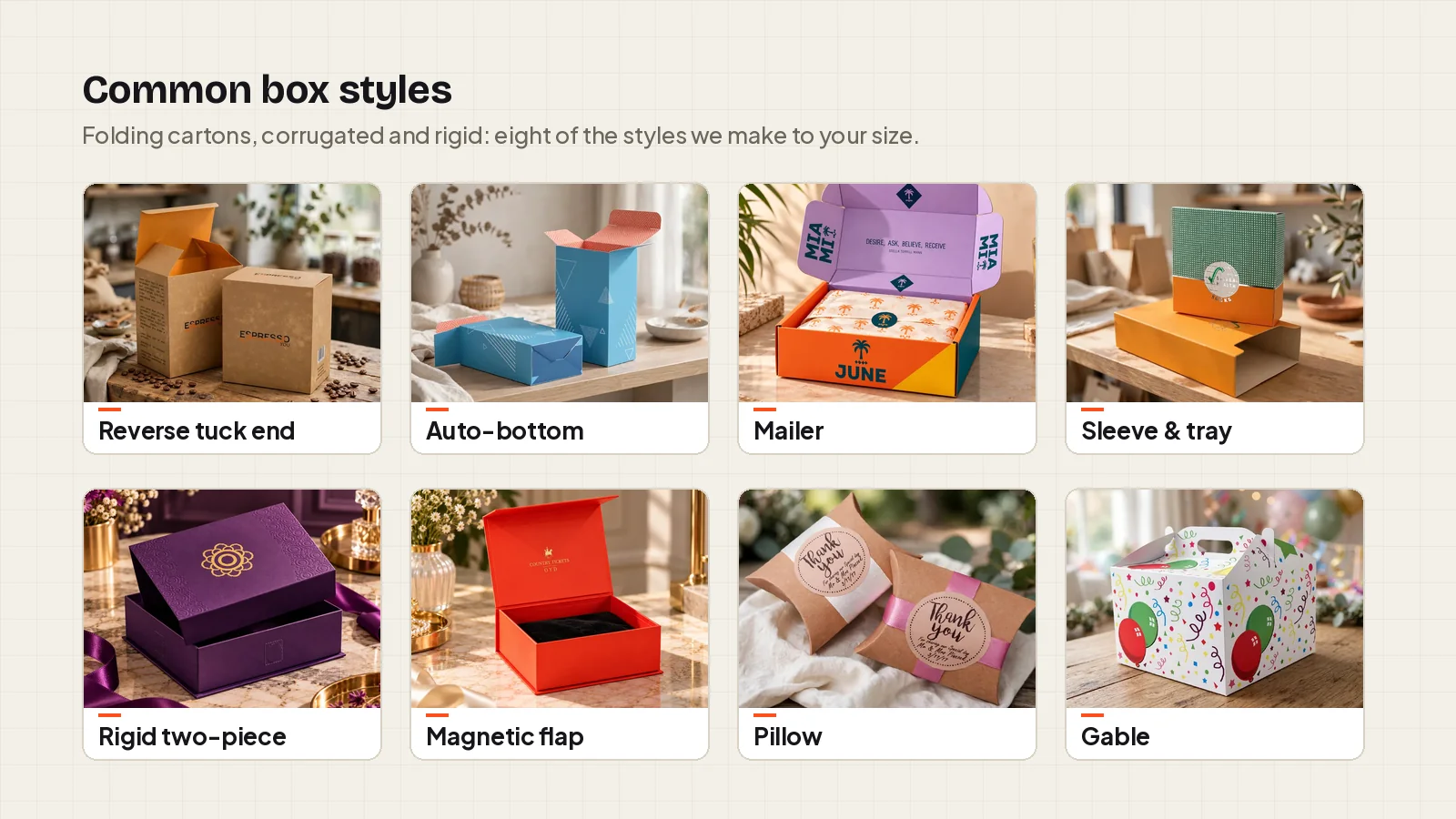
- Reverse tuck end — the top and bottom flaps tuck in from opposite sides. It is the most economical carton to cut and the usual choice for cosmetics, supplements and small goods.
- Straight tuck end — both flaps tuck in from the same side, so the front panel stays clean. Popular for boxes with a window or a display front.
- Seal end — the ends are glued shut, which suits cereal-style cartons and tamper evidence.
Auto-bottom and lock-bottom boxes
For heavier products, the base needs to be stronger than a tuck flap. An auto-bottom box (also called a crash-lock bottom) has a pre-glued base that springs into shape when the box is opened, so packing is fast. A lock-bottom box (also called 1-2-3 bottom) folds the base in by hand and interlocks — no glue, still strong. Both ship flat. Jars, bottles and candles are typical contents.
Mailer and shipping boxes
A mailer box is a one-piece corrugated box with a hinged lid, side dust flaps and a front tuck. It is strong enough to post without an outer carton and opens like a gift, which is why it is the favourite for e-commerce and subscription boxes. Shipping boxes (regular slotted cartons) close with four flaps and tape — plainer, but efficient for heavier or bulk goods.
Sleeve and tray, and two-piece boxes
A sleeve and tray box is two parts: a tray that holds the product and a printed sleeve that slides over it. The slide-out reveal makes it popular for chocolates, soap, tea and gift sets. A two-piece box has a separate lid and base; in rigid board it becomes the rigid two-piece box used for luxury presentation.
Rigid box styles
Rigid boxes do not fold flat (with one exception) and feel solid in the hand:
- Magnetic flap — a book-style lid held shut by a hidden magnet.
- Two-piece — a lid that lifts off a base, sometimes with a neck or shoulder.
- Sleeve and tray — a rigid drawer inside a sleeve.
- Collapsible — a rigid box that ships flat and snaps together with magnets, saving storage and freight.
Specialty styles
- Pillow boxes — curved ends that fold in along arced creases; ideal for small gifts and favours.
- Gable boxes — a built-in carry handle on top; bakery, party and takeaway.
- Handle boxes — carry handles on cartons that need to travel.
- Display boxes — counter-top trays with a printed header card that sell from the shelf.
- Hanging tab boxes — a tab with a hole for retail pegs.
- Dispenser boxes — a perforated opening to hand out products one at a time.
- Window boxes — a die-cut window, usually with clear film, to show the product.
How to choose a box style
| If your product is… | Consider |
|---|---|
| Light, sold on a shelf | Reverse or straight tuck end; window if the product sells itself |
| Heavy or in glass | Auto-bottom or lock-bottom carton, often with an insert |
| Sent by post | Corrugated mailer box; shipping box for bulk |
| A premium gift | Rigid magnetic flap, two-piece or sleeve and tray |
| Small and giftable | Pillow or sleeve and tray |
| Sold from a counter | Display box, or hanging tab for peg walls |
Still unsure? Browse by category and style in Find your box, or send us your product size through the quote form — our design team recommends a style and sets up the dieline at no charge. There is no minimum order, and you approve a free digital proof before anything is printed.
Frequently asked questions
What is the most common box style?
For retail cartons, the reverse tuck end is the most common because it is economical to cut and quick to pack. For e-commerce, the corrugated mailer box is the usual choice.
What is the difference between a tuck end and an auto-bottom box?
A tuck end box closes both ends with tuck flaps. An auto-bottom box has a pre-glued base that forms itself when the box is opened, so it holds heavier products and packs faster.
Which box style is best for shipping?
A corrugated mailer box for products sent directly to customers, and a regular slotted shipping box for heavier or bulk goods.
Do rigid boxes fold flat?
Most rigid boxes are delivered assembled. The exception is the collapsible rigid box, which ships flat and snaps into shape with magnets.
Can I get any box style in a custom size?
Yes. Every Pressholic box is cut from a fresh dieline to your size, with no minimum order. Our design team sets up the dieline at no charge.