Journal
Corrugated flute types explained: F, E, B, C and double wall
What is a flute?
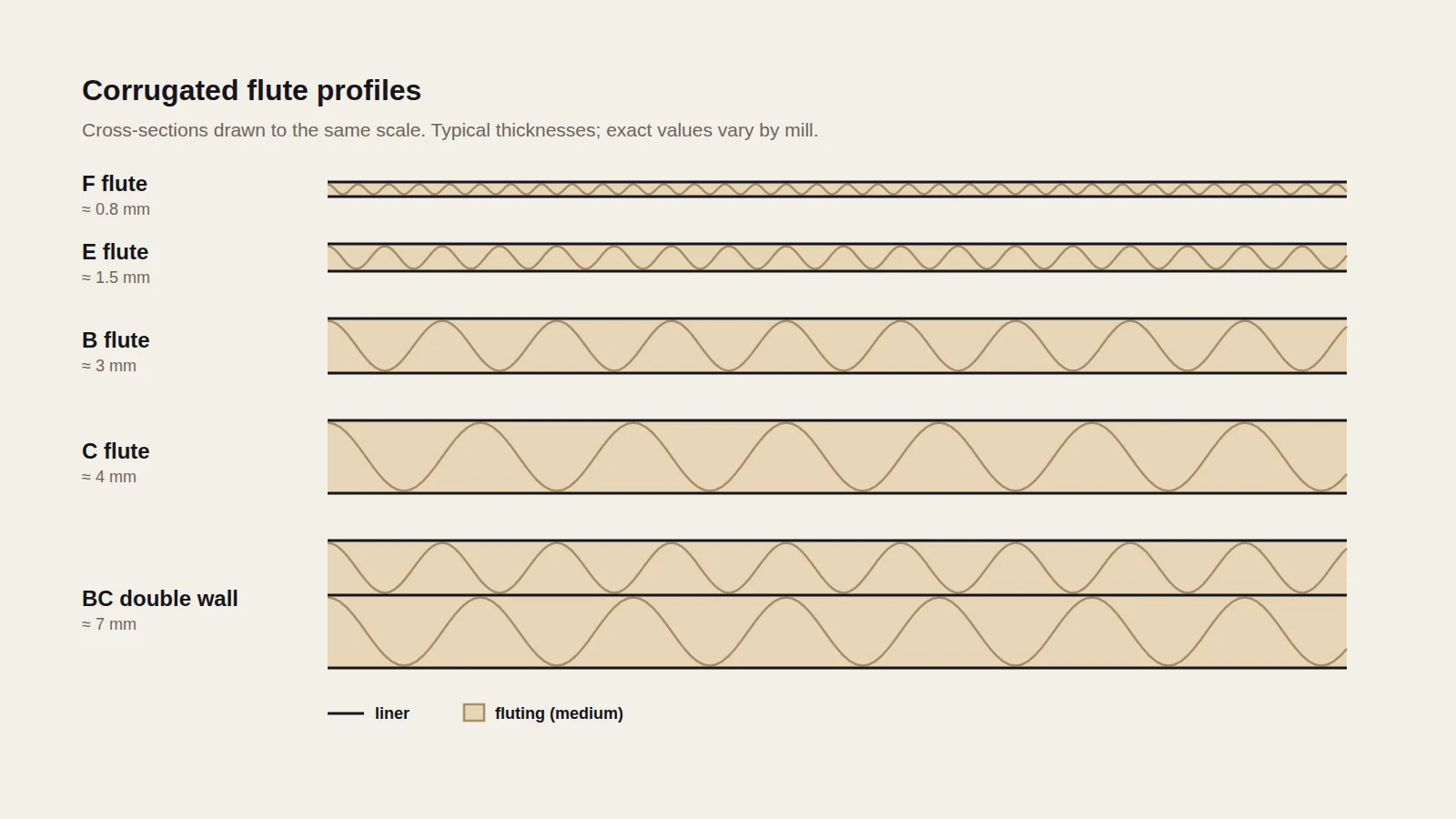
Corrugated board is a sandwich: a wavy sheet of paper called the fluting (or medium) glued between flat sheets called liners. The waves are the flutes. They hold the liners apart, which is what makes corrugated board stiff, light and cushioning at the same time.
Flutes are named by letter. The letters reflect the order in which the profiles were introduced rather than their size, so it helps to learn them by thickness: F is the thinnest, then E, B, C and A.
Flute sizes compared
| Flute | Typical thickness | Flutes per metre (approx.) | Best for |
|---|---|---|---|
| F | ≈ 0.8 mm | ≈ 400 | Small retail cartons that need the look of a folding carton with a little extra strength |
| E | ≈ 1.1–1.6 mm | ≈ 300 | Mailer boxes, cosmetic and subscription boxes; smooth surface for printing |
| B | ≈ 2.5–3.2 mm | ≈ 150 | Shipping boxes, heavier mailers, pizza boxes and displays |
| C | ≈ 3.6–4.2 mm | ≈ 130 | General shipping cartons; good cushioning and stacking strength |
| A | ≈ 4.8 mm | ≈ 110 | Maximum cushioning for fragile goods; less common today |
Exact values vary between mills and countries, so treat these as a guide. Your quote confirms the board for your box.
Single wall, double wall and triple wall
Single wall board has one fluted layer between two liners and covers most retail and e-commerce boxes. Double wall board stacks two fluted layers with three liners — for example BC (about 6.5–7 mm) or EB (about 4–4.5 mm). It is used for heavy contents, long transit and cartons that are stacked high. Triple wall is reserved for industrial loads and bulk containers.
How strength is measured
Two measurements are common. The edge crush test (ECT) measures how much load the board takes on its edge before it buckles, which relates to how well boxes stack. The burst (Mullen) test measures the pressure needed to puncture the board, which relates to rough handling.
Flute size is only part of the story: the weight and quality of the liners and fluting matter as much. If your courier, marketplace or retailer specifies a rating, include it in your request and we will confirm the board on your quote.
Printing on corrugated board
Fine flutes (E and F) give the flattest surface, so logos, fine text and photos print crisply straight onto the board. On coarser flutes (B and C) the waves can show through large areas of solid colour — an effect printers call "washboarding".
When a box needs both strength and photographic print quality, the artwork can be printed on a separate sheet and laminated onto the corrugated board. This is common for premium mailer boxes and display boxes.
Which flute should you choose?
- E-commerce mailer boxes: E flute for a crisp, printed unboxing; B flute when the contents are heavier. See mailer boxes.
- Shipping cartons: B or C flute, moving to double wall for heavy or fragile goods. See shipping boxes.
- Retail displays: E or B flute, depending on the weight on each shelf. See display boxes.
- Food to go: E or B flute keeps heat in and the box rigid. See pizza boxes.
Choosing between corrugated and folding carton board in the first place? Our guide to cardboard and cardstock compares them. All of our corrugated boxes are printed to your size with no minimum order.
Frequently asked questions
Which corrugated flute is the strongest?
Among single-wall boards, the larger flutes (C and A) cushion and stack best; double-wall boards such as BC are stronger still. Liner and fluting weights matter as much as flute size, so strength is best compared using a rated board.
What flute are mailer boxes usually made from?
E flute is the most common choice because it is thin, folds neatly and prints well. B flute is used when the contents are heavier or need more cushioning.
Is E flute or B flute better for printing?
E flute. Its finer waves give a flatter surface, so fine detail and solid colours print more evenly than on B flute.
What does double wall mean?
Double wall board has two fluted layers and three liners — for example BC flute, about 6.5–7 mm thick. It is used for heavy contents, long transit and tall stacks.
Can I choose a white or kraft outer liner?
Yes. Corrugated boxes can have a brown kraft or a white outer liner; white gives brighter colours, kraft gives a natural look. Your quote confirms the liner and flute for your box.