
Journal
Rigid box vs folding carton: what is the difference and which should you choose?
The short answer
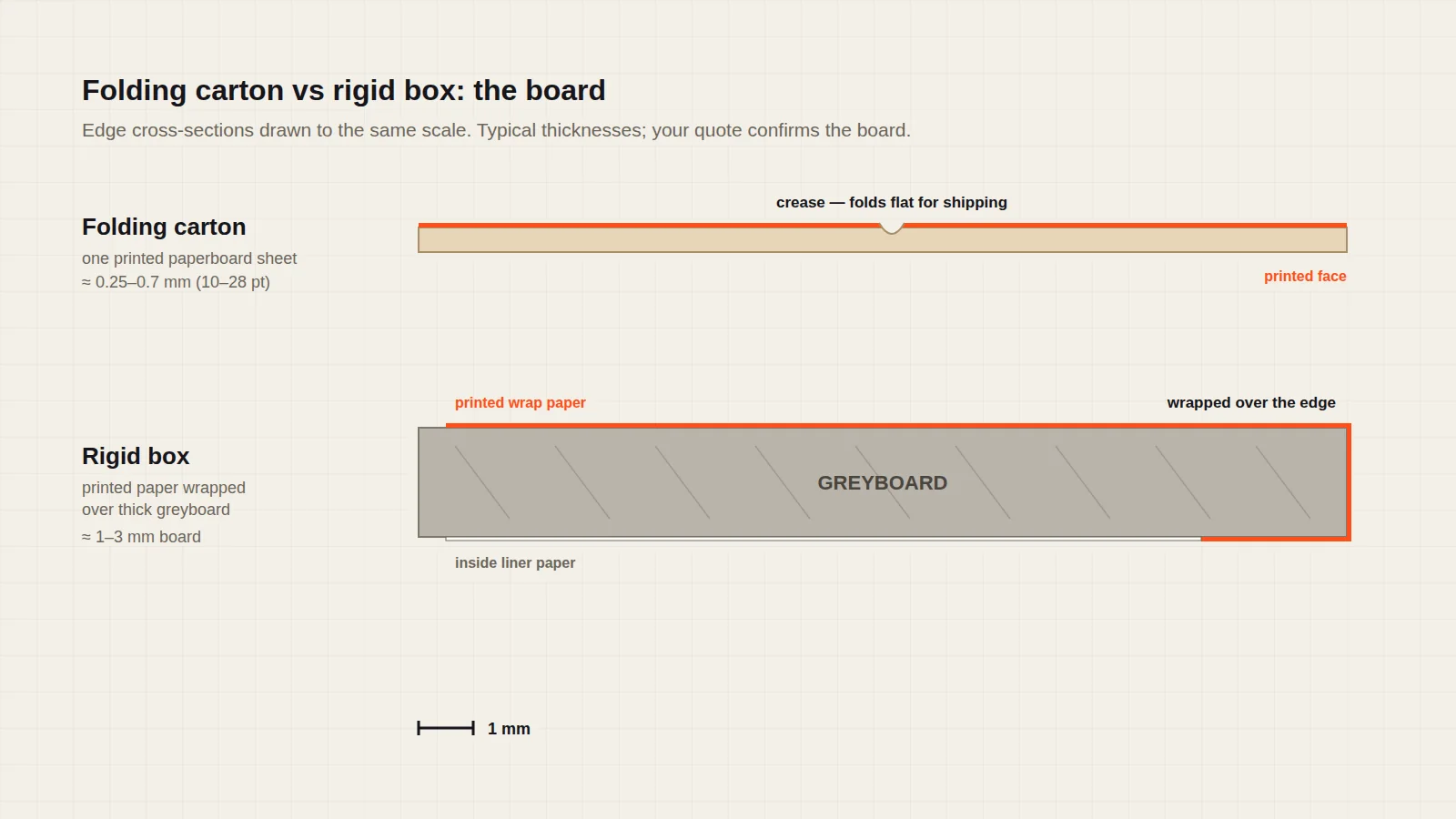
A folding carton is made from a single sheet of printed paperboard that is cut, creased and delivered flat, then folded into shape when you pack it. A rigid box is built from thick greyboard that is wrapped in printed paper and usually delivered already assembled. Folding cartons are the everyday retail box; rigid boxes are the premium presentation box.
Side by side
| Folding carton | Rigid box | |
|---|---|---|
| Board | Paperboard, typically 0.25–0.7 mm (about 10–28 pt) | Greyboard, typically about 1–3 mm, wrapped in printed paper |
| Printing | Printed directly on the board | Printed on the wrap paper, which is glued around the board |
| Delivery | Flat, glued where needed | Usually assembled (collapsible rigid boxes ship flat) |
| Storage and freight | Compact — many boxes per carton | Takes more space; freight per box is higher |
| Feel | Light, practical | Heavy, solid, premium |
| Packing | Folded by hand or machine | Ready to use; lid lifts or opens |
| Typical uses | Cosmetics, supplements, food, retail | Jewellery, perfume, electronics, gift sets, PR boxes |
Thicknesses vary by board and supplier, so treat these as typical values. Your quote confirms the board for your box.
How each is made
Folding cartons are printed on large sheets, cut and creased in one pass by a die made from the dieline, then folded and glued along the side seam. They are delivered flat and formed at packing time.
Rigid boxes start as greyboard panels that are cut and joined into a tray and lid. The printed wrap paper is glued over the outside and turned in over the edges, and a liner paper covers the inside. Magnets, ribbons and inserts are added before the box is finished. Our guide to rigid boxes goes into more detail.
Look and feel
Both take full-colour print and finishes such as matte, gloss or soft-touch lamination, foil, spot UV and embossing. The difference is weight and edge: a rigid box has crisp, thick walls and opens with a slow, deliberate feel, which is why brands use it for unboxing and gifting. A well-printed folding carton looks sharp on the shelf and keeps packaging light.
Cost and logistics
Per box, rigid boxes typically cost more than folding cartons: more board, more hand work and more space in transit. Folding cartons are the economical choice for large runs and for products that are shipped in an outer carton anyway. If you like the rigid look but storage or freight is a concern, a collapsible rigid box ships flat.
At Pressholic, both are made to your size with no minimum order, and production takes 7–14 working days after final proof approval and full payment.
Which should you choose?
- Choose a folding carton for retail shelves, e-commerce inserts, food and cosmetics, larger runs and anything where weight and storage matter. Styles: reverse tuck end, auto-bottom, sleeve and tray.
- Choose a rigid box when the box is part of the product: gifts, jewellery, perfume, launches and influencer kits. Styles: magnetic flap, two-piece, rigid sleeve and tray.
Not sure? Tell us what goes inside through the quote form and our design team will suggest both options. See all rigid boxes or all folding carton styles.
Frequently asked questions
Is a rigid box the same as a set-up box?
Yes. "Set-up box" is the traditional trade name for a rigid box, because it is delivered already set up rather than flat.
Are rigid boxes stronger than folding cartons?
Yes. The thick greyboard walls resist crushing much better than paperboard, which is one reason rigid boxes are used for fragile and high-value products.
Can a rigid box ship flat?
A collapsible rigid box can. It is delivered flat and snaps into shape with magnets, saving storage space and freight.
Can folding cartons have premium finishes?
Yes. Folding cartons take foil, spot UV, embossing and soft-touch lamination just like rigid boxes, so they can look premium while staying light and flat-packed.
Is there a minimum order for rigid boxes?
No. Pressholic has no minimum order quantity for rigid boxes or folding cartons.