Journal
Spot UV vs foil vs holographic: choosing a premium box finish
The short answer
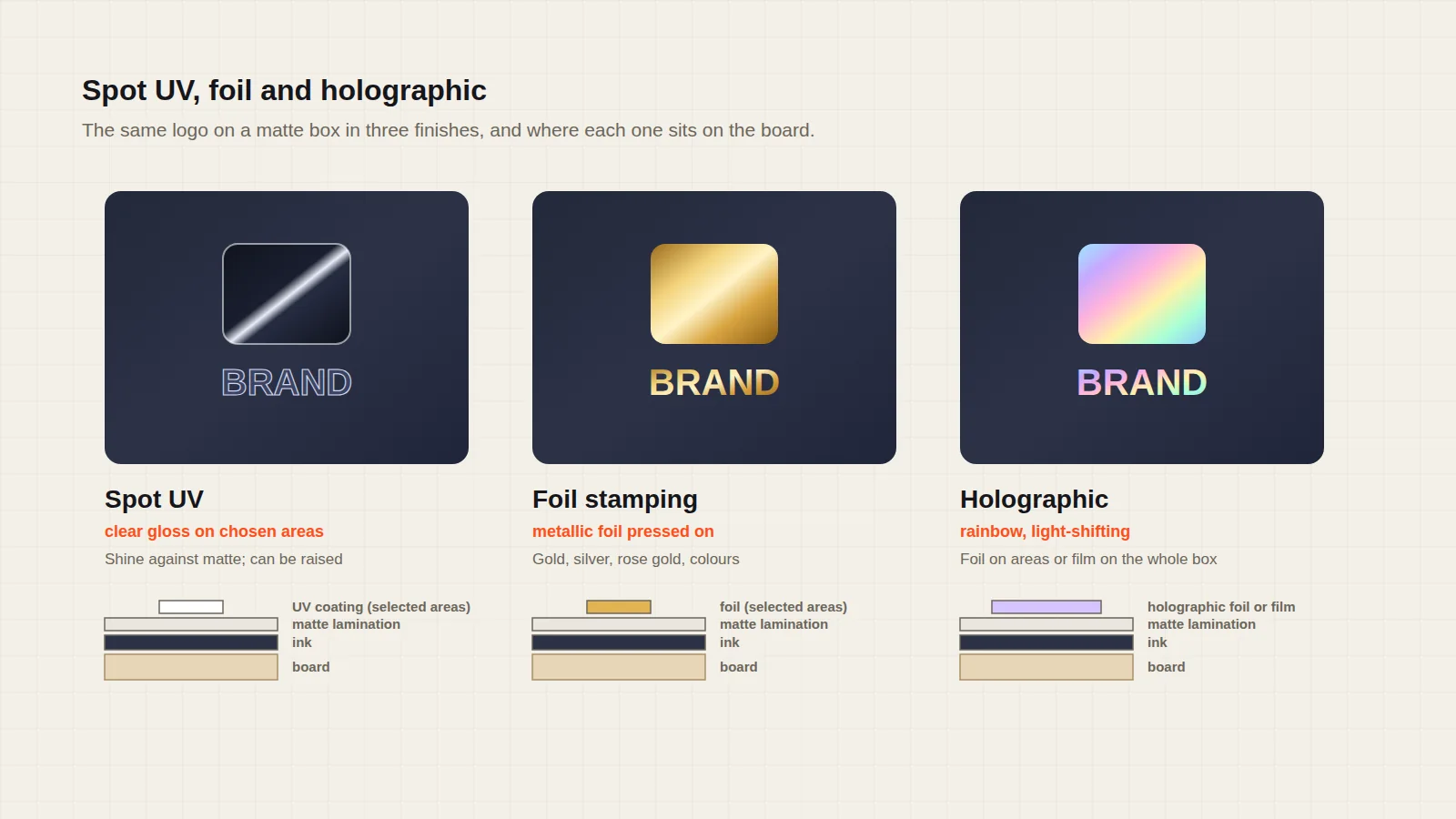
All three are embellishments: they sit on top of the printed, laminated box and pick out part of the design.
- Spot UV is a clear, glossy coating applied only to chosen areas — a logo, a pattern, a line of text. It shines against a matte background and can be built up so you feel it.
- Foil stamping transfers a thin metallic or coloured foil onto the board with a heated die and pressure. Gold, silver and rose gold are the classics.
- Holographic finishes shift through rainbow colours as the box moves. They are applied as a holographic foil on chosen areas or as a holographic film or board across the whole box.
Choose spot UV for subtle contrast, foil for a metallic luxury cue, and holographic when you want the box to catch the eye from across a room.
Spot UV: gloss where you want it
A UV-curable varnish is laid onto selected areas, usually by screen or a digital coating press, and hardened instantly under ultraviolet light. Because it is clear, it takes the colour of the print underneath and changes only the sheen.
- Works best on matte or soft-touch lamination, where the contrast between flat and shiny is strongest. On gloss lamination it almost disappears.
- Raised spot UV builds the coating thicker so the logo or pattern stands up from the surface — a texture effect without a die.
- Looks quiet and modern: dark boxes with a gloss logo, patterns that appear when the light catches them.
Foil stamping: metallic and coloured foils
In hot foil stamping a metal die is heated and pressed through a foil ribbon onto the box, leaving the foil only where the die touches. Each foil colour needs its own die and its own pass through the machine; with us, dies and printing plates are not charged separately.
- Colours: gold, silver, rose gold and copper are the most asked for; coloured, matte-metallic and pearlescent foils are also available.
- Combines with embossing: foil and embossing can be done together so the metallic area is also raised.
- Looks premium and traditional: gift, fragrance, jewellery, spirits and cosmetic packaging.
Cold foil is a different process: an adhesive is printed on press, foil sticks to it, and ink can be printed over the top to make any metallic colour. It suits long runs with large or detailed metallic areas.
Holographic: foil, film or board
Holographic effects come from a microscopic pattern embossed into a metallised film, which splits light into rainbow colours. There are three common ways to use it:
- Holographic foil stamped on selected areas, exactly like a metallic foil — a holographic logo on a plain box.
- Holographic film lamination across the whole printed sheet, so the full box shimmers.
- Holographic (metallised) board, printed on directly. White ink is printed under the areas that should look solid, so only the unprinted parts shine.
Patterns range from plain rainbow to sparkle, pillars and repeating designs. Holographic finishes are popular for cosmetics, beauty, streetwear, CBD and confectionery.
Side by side
| Spot UV | Foil stamping | Holographic | |
|---|---|---|---|
| What it adds | Clear gloss (optionally raised) | Metallic or coloured foil | Rainbow, light-shifting shine |
| Coverage | Selected areas | Selected areas | Selected areas (foil) or whole box (film or board) |
| Needs a die | No | Yes, one per foil colour | Foil: yes; film or board: no |
| Best base | Matte or soft-touch | Matte, soft-touch or uncoated | Dark or matte print for contrast |
| Feel | Smooth; raised if built up | Flat or raised with embossing | Smooth |
| Main cost drivers | Area covered; raised build | Number of foil colours and their size | Coverage and whether film, board or foil is used |
Prices depend on quantity, box size and how much of the box is covered, so ask us to quote the same box with and without the finish.
Combining finishes
- Soft-touch + spot UV — a velvety box with a glossy logo; strong contrast in the hand.
- Matte + foil + embossing — the classic luxury combination for gift and fragrance boxes.
- Holographic + spot UV — gloss accents over a shimmering base for a layered look.
- One hero finish is usually enough on small cartons; two finishes on a tiny panel compete with each other.
Matte or gloss lamination is included at no additional lamination charge (soft-touch is a paid add-on), and our guide to matte, gloss and soft-touch explains which base to pick.
Setting up artwork for a finish
- Put the finish on its own layer or as a named spot colour (for example “Spot UV” or “Foil gold”), as vector artwork, 100% of one colour, in the exact position over the print.
- Keep very fine lines, tiny text and hairline gaps out of foil and spot UV areas — they may not reproduce cleanly. We flag anything too fine when we check your files.
- Keep finishes away from folds and glue areas, and inside the safe area of the dieline.
- For holographic board, mark which areas get a white underlayer and which should shine.
Every order comes with free design help and a free digital proof (flat and 3D) that shows each finish layer before production.
A note on recycling
Coatings, foils and films add small amounts of non-paper material. Many paper recycling systems accept foiled and coated cartons, but rules vary by area, and full holographic film or metallised board can be treated differently. If recyclability matters for your brand, tell us and we will suggest options such as spot UV or foil on selected areas instead of a full film.
Frequently asked questions
What is the difference between spot UV and gloss lamination?
Gloss lamination is a film over the whole box, so everything shines. Spot UV is a clear coating on chosen areas only, usually over matte lamination, so those areas shine against a flat background.
Can I use foil and spot UV on the same box?
Yes. Foil for the logo and spot UV for a pattern or secondary details is a common combination. Each finish needs its own artwork layer.
Is holographic the same as foil?
Holographic can be a foil, stamped on selected areas like gold or silver, but it can also be a film laminated over the whole box or a metallised board printed directly.
Which finish works best for small text?
Print is the most precise. Spot UV and foil can reproduce fine detail, but very thin lines and tiny text may not come out cleanly, so keep them larger in finish areas.
How do I send artwork for foil or spot UV?
Supply vector artwork with the finish on its own layer or as a named spot colour, positioned exactly over the print. Our design team checks it and shows every layer on your free digital proof.